In 1862, when Victor Hugo published Les Misérables, France was still reckoning with revolution, industrial expansion and the unfinished promises of democracy. Hugo, already a celebrated writer and political exile, delivered something far larger than a novel. He constructed a moral epic — sweeping in scope, radical in empathy and unapologetically political.
More than a century and a half later, Les Misérables remains one of the most widely read, adapted and performed works in world literature. Its endurance is not rooted in nostalgia but in urgency. The questions Hugo posed in the 19th century continue to echo through the present.
At the center stands Jean Valjean, imprisoned for stealing bread to feed hungry children. Nineteen years later, hardened and marked as dangerous, he reenters a world unwilling to forgive. In one of literature’s most luminous scenes, a bishop’s act of mercy alters the course of his life. The gift of silver candlesticks becomes a moral inheritance. Valjean resolves to transform himself.
Opposing him is Inspector Javert, the embodiment of law as absolute doctrine. Where Valjean evolves, Javert does not. Their pursuit unfolds across decades, but Hugo’s true drama is philosophical: is morality found in obedience, or in compassion?
Around them swirls an entire society. Fantine’s descent into destitution exposes the brutal vulnerability of women without protection. Cosette’s childhood servitude at the hands of the conniving Thénardiers reveals exploitation masked as guardianship. Young revolutionaries gather on the barricades of 1832, convinced history can be forced toward justice. Even Paris’s sewer system earns chapters of reflection, as Hugo insists that no aspect of society is beneath examination.
If the novel is expansive, its afterlife on screen and stage has been equally prolific.
From the bookshelves to the Hollywood
Long before Broadway and Hollywood embraced the story, French filmmakers treated Les Misérables as sacred national material.
Among the most revered adaptations is the 1934 film directed by Raymond Bernard, a nearly five-hour production that remains one of the most faithful interpretations of Hugo’s moral architecture. Its deliberate pacing allowed space for the novel’s philosophical weight, preserving its social critique rather than streamlining it.
The 1958 adaptation directed by Jean-Paul Le Chanois brought renewed grandeur, with Jean Gabin as Valjean. Gabin’s performance carried the gravitas of postwar France. His Valjean felt less like a romantic hero and more like a man shaped by suffering and endurance — a reflection of a nation rebuilding after occupation and war.
In 1982, director Robert Hossein offered another significant French version, starring Lino Ventura as Valjean. Ventura, known for his understated strength, delivered a restrained and disciplined portrayal. His Valjean was defined not by spectacle but by moral stamina. Opposite him, Michel Bouquet’s Javert embodied icy inflexibility. This adaptation narrowed its focus to the psychological duel at the story’s core, emphasizing internal conflict over grand scale.
French television revisited the novel again in 2000 in a sweeping miniseries directed by Josée Dayan and starring Gérard Depardieu as Valjean alongside John Malkovich as Javert. This version leaned into character study, highlighting the emotional fragility beneath institutional rigidity.
Hollywood also repeatedly returned to Hugo’s epic, producing notable versions in 1935 and 1952. Yet it was the 2012 film Les Misérables, directed by Tom Hooper, that reintroduced the story to a vast global audience in the 21st century.
Unlike earlier dramatic adaptations, the 2012 film drew from the stage musical rather than directly from Hugo’s text. Starring Hugh Jackman as Valjean, Russell Crowe as Javert and Anne Hathaway as Fantine, it embraced operatic intensity. Its most distinctive artistic choice was recording the actors’ singing live on set, favoring emotional immediacy over technical polish.
Hathaway’s performance of “I Dreamed a Dream,” delivered in a single unbroken close-up, became the emotional centerpiece. The film grossed more than $400 million worldwide, reaffirming that Hugo’s themes of poverty, dignity and redemption continue to resonate across generations.
Each adaptation reflects its era. French versions often emphasize social realism and philosophical nuance. Hollywood leans toward emotional crescendo and spectacle. Yet the essential tension remains unchanged: a man seeking redemption in a society reluctant to grant it.
The Musical That Conquered the World
 The
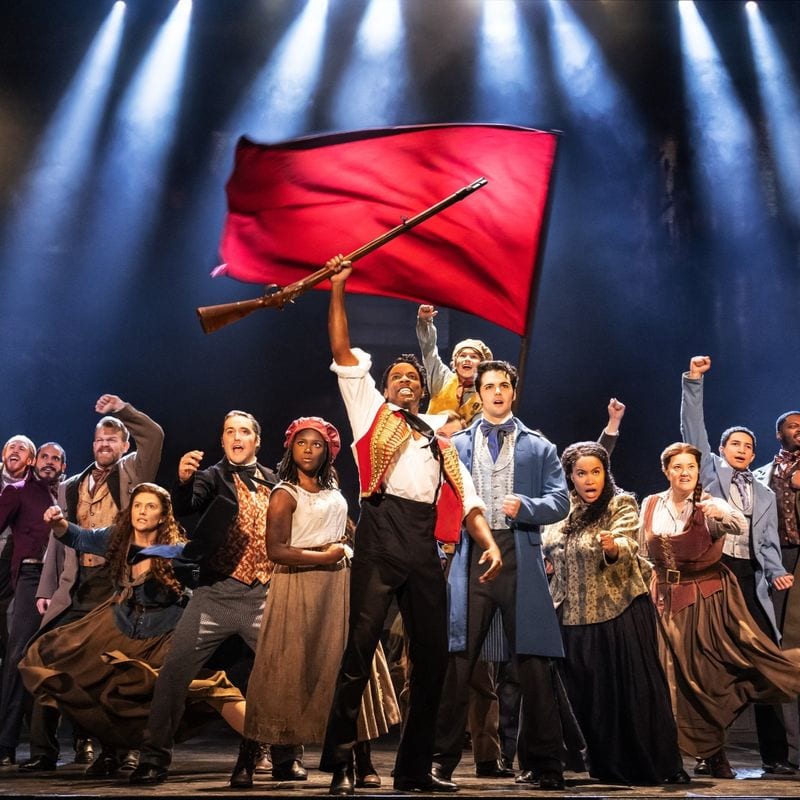
transformation of Les Misérables into a global theatrical phenomenon began in Paris in 1980 with Les Misérables, created
by Claude-Michel Schönberg and Alain Boublil.
The
transformation of Les Misérables into a global theatrical phenomenon began in Paris in 1980 with Les Misérables, created
by Claude-Michel Schönberg and Alain Boublil.
Its early reception was cautious. But when producer Cameron Mackintosh launched the English-language version in London in 1985, audiences responded with fervor. The show became one of the longest-running musicals in theater history. It transferred to Broadway, toured internationally and has been translated into more than 20 languages.
The musical condenses Hugo’s sprawling narrative into soaring anthems. “On My Own” captures longing in three minutes. “Bring Him Home” transforms prayer into aria. “Do You Hear the People Sing?” has traveled beyond theater walls, resurfacing at political protests across continents.
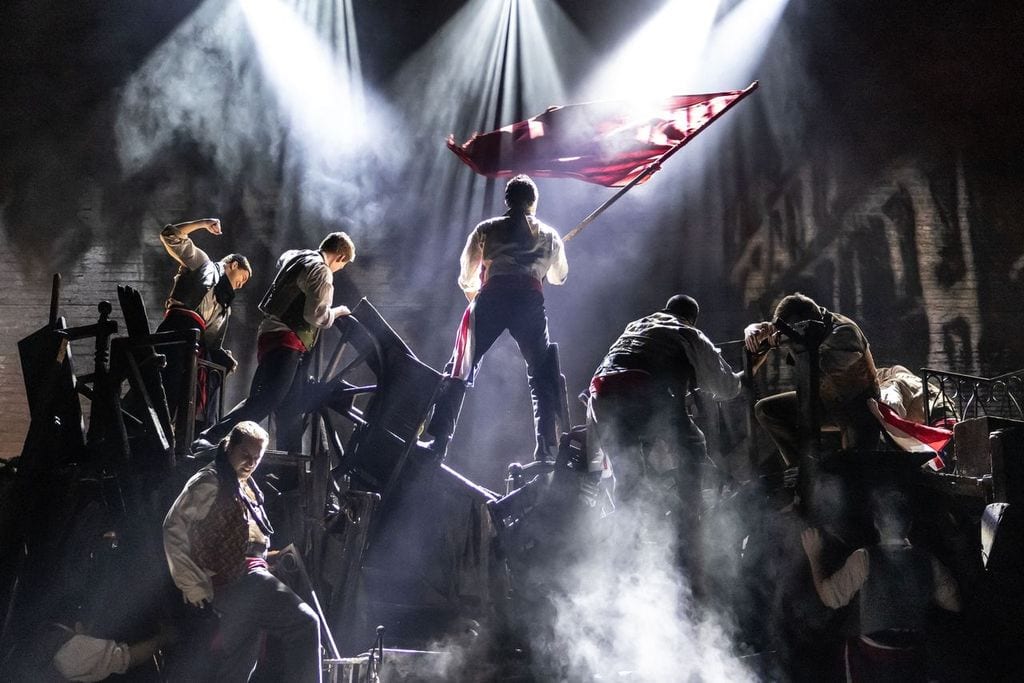
Where Hugo devoted pages to philosophical inquiry, the musical distills ideology into melody. The barricade — constructed from broken furniture and revolutionary hope — has become one of the most iconic stage images in modern theater.
Still a Mirror to Our Time
In 2026, Les Misérables does not feel distant. It feels unsettlingly contemporary.
Jean Valjean’s original offense — stealing a loaf of bread to feed hungry children — was an act born of necessity. The punishment was not measured; it was crushing. Hugo does not frame Valjean as a criminal in the traditional sense. He frames him as a man trapped by circumstance, then trapped again by a system unwilling to distinguish between survival and wrongdoing.
The novel opens a deeper reflection: when a crime is committed out of desperation, it should not be harshly sanctioned as though it were born of greed or malice. Justice without mercy becomes injustice. Punishment without proportion becomes cruelty.
In a modern world still debating sentencing reform and the consequences of minor offenses, Les Misérables feels less like a historical drama and more like an argument. It suggests that necessity complicates guilt — and that forgiveness, far from weakening society, may in fact strengthen it.
More than a story of misery, Hugo’s epic remains a testament to resilience — and to the enduring belief that compassion is not weakness, but the highest form of justice.
For Bay Area audiences, the story will soon move from page and screen to the stage. The acclaimed touring production of Les Misérables will come to Broadway San Jose this spring, with the support of Alliance Française Silicon Valley, helping bring the legendary musical to Silicon Valley.
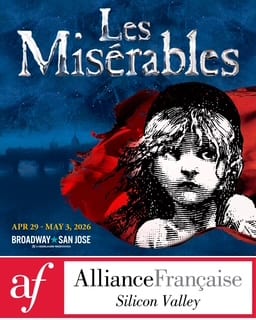 The production will run April 29 through May 3, 2026, with only eight performances scheduled. For theater lovers and
longtime fans of Victor Hugo’s masterpiece, the engagement offers a rare chance to experience the sweeping musical live — from the
thunderous chorus of “Do You Hear the People Sing?” to the intimate emotion of “Bring Him Home.”
The production will run April 29 through May 3, 2026, with only eight performances scheduled. For theater lovers and
longtime fans of Victor Hugo’s masterpiece, the engagement offers a rare chance to experience the sweeping musical live — from the
thunderous chorus of “Do You Hear the People Sing?” to the intimate emotion of “Bring Him Home.”
Presented at the San Jose Center for the Performing Arts, the show is part of Broadway San Jose’s touring season and brings one of the world’s most celebrated musicals to the heart of Silicon Valley.
Tickets are already on sale, and with only a limited number of performances scheduled, audiences are encouraged to book early.
🎟 Reserve your seats:
https://broadwaysanjose.com/shows/les-miserables/
For those who have read the novel, seen the films or listened to the music for years, this staging offers something unique: the chance to experience Hugo’s timeless story unfold live, with the power of a full orchestra, chorus and stage production.
Tuesdays 2-6pm
Thursdays 10am-2pm
Saturdays 10am-12pm
Alliance Française Silicon Valley
Los Gatos, CA 95032

Leave a Comment